Skip to content Skip to sidebar Skip to footer

Artificial Intelligence

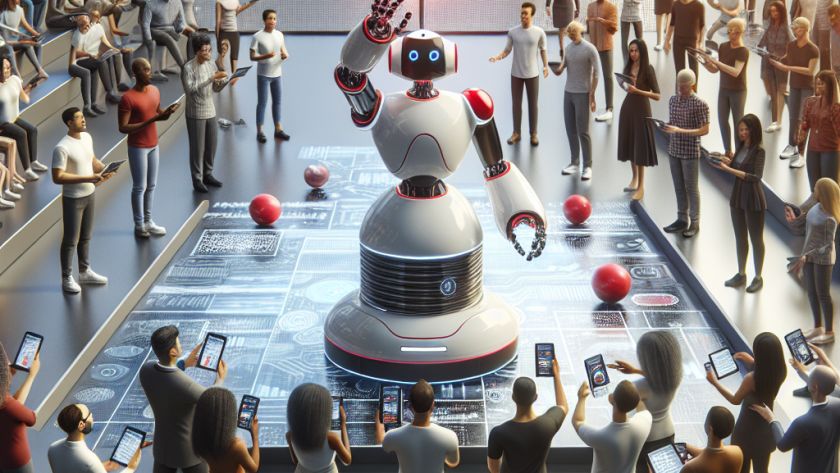
A novel approach employs collective public input to assist in educating robots.

Reinforcement learning, which involves teaching an AI agent a new task using a trial and error methodology, often requires the assistance of a human expert to create and modify the reward function. However, this can be time-consuming, inefficient and difficult to upscale, particularly when the task is highly complex and involves several stages. In response…
Read More

What does the future entail for generative artificial intelligence?

In a keynote address at MIT's Generative AI Week on November 28, iRobot co-founder Rodney Brooks highlighted the potential dangers of overestimating the capabilities of generative AI, an emerging technology that supports powerful tools like OpenAI’s ChatGPT and Google’s Bard. He urged that while the technology has significant capabilities, the illusion that it can solve…

Read More

Examination of Knowledge Discrepancies in Extensive Language Models: Methods for Improved Precision and Dependability

Large language models (LLMs) have emerged as powerful tools in artificial intelligence, providing improvements in areas such as conversational AI and complex analytical tasks. However, while these models have the capacity to sift through and apply extensive amounts of data, they also face significant challenges, particularly in the field of 'knowledge conflicts'. Knowledge conflicts occur when…

Read More

VideoMamba: An Exclusively SSM-oriented AI Architecture for Effective Video Comprehension

Video understanding, which involves parsing and interpreting visual content and temporal dynamics within video sequences, is a complex domain. Traditional methods like 3D convolutional neural networks (CNNs) and video transformers have seen steady advancement, but often they fail to effectively manage local redundancy and global dependencies. Amidst this, the emergence of the VideoMamba, developed based…

Read More

Microsoft Unveils AutoDev: A Completely Automated Software Development Platform Powered by Artificial Intelligence.

The software development sector is set to undergo a significant transformation led by artificial intelligence (AI), with AI agents performing a diverse range of development tasks. This transformation goes beyond incremental improvements to reimagine the way software engineering tasks are performed and delivered. A key part of this change is the advent of AI-driven frameworks,…

Read More

SuperAGI Introduces Veagle: Trailblazing the Future of Multi-faceted AI through Advanced Vision-Language Unification

The blending of linguistic and visual information represents an emerging field in Artificial Intelligence (AI). As multimodal models evolve, they offer new ways for machine comprehension to interact with visual and textual data. This step beyond the traditional capacity of large language models (LLMs) involves creating detailed image captions and responding accurately to visual questions. Integrating…

Read More

Introducing VisionGPT-3D: Combining Top-tier Vision Models for Creating 3D Structures from 2D Images

The fusion of text and visual components has transformed daily routines, such as image generation and element identification. While past computer vision models focused on object detection and categorization, larger language models like OpenAI GPT-4 have bridged the gap between natural language and visual representation. Although models like GPT-4 and SORA have made significant strides,…

Read More

MIT scientists have created an image dataset enabling the imitation of peripheral vision within machine learning models.

Researchers from Massachusetts Institute of Technology (MIT) have developed the Texture Tiling Model (TTM), a technique intended to address issues faced when attempting to model human visual perception accurately within deep neural networks (DNNs), and particularly peripheral vision. This area of vision, which views the world with less fidelity further away from the focal center,…

Read More

Scientists from NTU Singapore have suggested a new and effective diffusion method for Image Restoration IR, which considerably cuts down the number of necessary diffusion stages.

Image Restoration (IR) is a key aspect of computer vision that aims to retrieve high-quality images from their degraded versions. Traditional techniques have made significant progress in this area; however, they have recently been outperformed by Diffusion Models, a technique that's emerging as a highly effective method in image restoration. Yet, existing Diffusion Models often…

Read More

A novel approach incorporates feedback from the public to assist in teaching robots.

Researchers from MIT, Harvard, and the University of Washington have developed a new method for training AI agents using reinforcement learning. Their approach replaces a process often involving a time-consuming design of a reward function by a human expert with feedback crowdsourced from non-expert users. Traditionally, AI reinforcement learning has used a reward function, designed by…

Read More

What does the prospect look like for generative AI in the future?

At the Generative AI: Shaping the Future symposium, Rodney Brooks, keynote speaker and co-founder of iRobot, cautioned against overestimating the capabilities of Generative AI. The technology supports powerful tools like OpenAI’s ChatGPT and Google’s Bard, but Brooks argued that no single technology ever exceeds all others. He stressed the importance of responsible development and use…

Read More