Windows 11, known for its cutting-edge features, sometimes faces network connection issues. This guide lays out several steps to resolve this situation.
Before proceeding with complex steps, ensure the network functions correctly by verifying if other devices connected to the same network can access the internet. If the problem lies within the computer, follow the…

Large Vision-Language Models (LVLMs), which interpret visual data and create corresponding text descriptions, represent a significant advancement toward enabling machines to perceive and describe the world like humans do. However, a primary challenge obstructing their widespread use is the occurrence of hallucinations, where there is a disconnect between the visual data and the generated text,…
Optical flow estimation, a key aspect of computer vision, enables the prediction of per-pixel motion between sequential images. It is used to drive advances in various applications ranging from action recognition and video interpolation, to autonomous navigation and object tracking systems. Traditionally, advancements in this area are driven by more complex models aimed at achieving…
The development of large language models (LLMs) that can understand and interpret the subtleties of human language is a complex challenge in natural language processing (NLP). Even then, a significant gap remains, especially in the models' capacity to understand and use context-specific linguistic features. Researchers from Georgetown University and Apple have made strides in this…
Python project dependency management can often be challenging, especially when working with both Python and non-Python packages. This issue can give rise to confusion and inefficiencies due to the juggling of multiple dependency files. UniDep, a versatile tool, was designed to simplify and streamline Python dependency management. It has proven to be significantly useful for…
Large Language Models (LLMs) like ChatGPT and Llama have performed impressively in numerous Artificial Intelligence (AI) applications, demonstrating proficiency in tasks such as question answering, text summarization, and content generation. Despite their advancements, concerns about their misuse, in propagating false information and abetting illegal activities, persist. To mitigate these, researchers are committed to incorporating alignment…
Recent developments have focused on creating practical and powerful models applicable in different contexts. The narrative primarily revolves around striking a balance between the creation of expansive language models capable of comprehending and generating human language, and the practicality of deploying these models effectively in resource-limited environments. The problem is even more acute when these…
Advancements in large language models (LLMs) are making strides in the field of automated computer code generation in artificial intelligence (AI). These sophisticated models are proficient in creating code snippets from natural language instructions due to extensive training on large datasets of programming languages. However, challenges remain in aligning these models with the intricate needs…
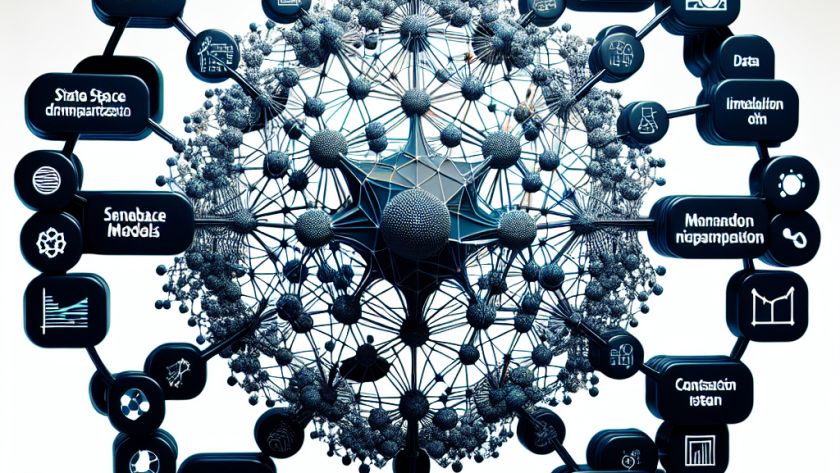
The scalability of Graph Transformers in graph sequence modeling is hindered by high computational costs: a challenge that existing attention sparsification methods are not fully addressing. While models like Mamba, a state space model (SSM), are successful in long-range sequential data modeling, their application to non-sequential graph data is a complex task. Many sequence models…
Artificial intelligence, particularly large language models (LLMs), has advanced significantly due to reinforcement learning from human feedback (RLHF). However, there are still challenges associated with creating original content purely based on this feedback.
The development of LLMs has always grappled with optimizing learning from human feedback. Ideally, machine-generated responses are refined to closely mimic what a…
Large language models (LLMs) have proven beneficial across various tasks and scenarios. However, their evaluation process is riddled with complexities, primarily due to the lack of sufficient benchmarks and the required significant human input. Therefore, researchers urgently need innovative solutions to assess the capabilities of LLMs in all situations accurately.
Many techniques primarily lean on automated…
Researchers from Pinterest have developed a reinforcement learning framework to enhance diffusion models - a set of generative models in Machine Learning that add noise to training data and then learn to recover it. This exciting advancement allows the models to accomplish top-tier image quality. These models' performance, however, largely relies on the training data's…