
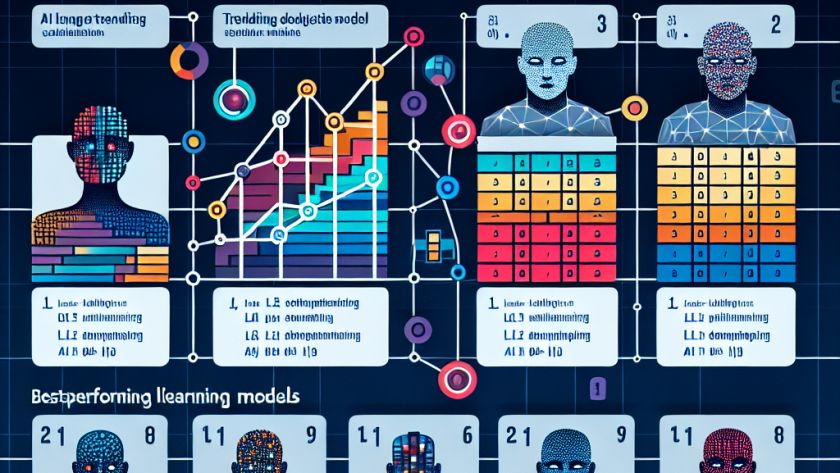


In the rapidly evolving field of Vision-and-Language (VL) representation learning, researchers strive to integrate visual and textual information to boost the performance of machine learning models. This integration promotes simultaneous understanding and processing of images and text, enhancing outcomes for tasks such as image captioning, visual question answering (VQA), and image-text retrieval. However, a major…

Large Language Models (LLMs) have shown great potential in natural language processing tasks such as summarization and question answering, using zero-shot and few-shot prompting approaches. However, these prompts are insufficient for enabling LLMs to operate as agents navigating environments to carry out complex, multi-step tasks. One reason for this is the lack of adequate training…



Intel, known for its leading-edge technology, offers a variety of AI courses that provide hands-on training for real-world applications. These courses are tailored to understanding and effectively using Intel's broad AI portfolio, with a focus on deep learning, computer vision, and more. The courses cover a wide range of topics, providing comprehensive learning for those…


Researchers from MIT, Brigham and Women’s Hospital, and Duke University have pioneered a multifaceted approach to determine the transporters used by various drugs to exit the digestive tract. Leveraging tissue models and machine-learning algorithms, the team has discovered that doxycycline (an antibiotic) and warfarin (a blood thinner) can interfere with each other’s absorption.
All orally consumed…


MIT researchers have developed a technique to train robots on multiple tasks by combining and optimising data from a variety of sources. At the core of their work is a type of generative AI known as a 'diffusion model', which learns from a specific dataset to complete a task. However, the particular innovation here lies…